Japan, 2011
E5 Hayabusa: Fifteen Metres to Shape the Air
 ▶ Play timeline ▶ Watch on YouTube ↗
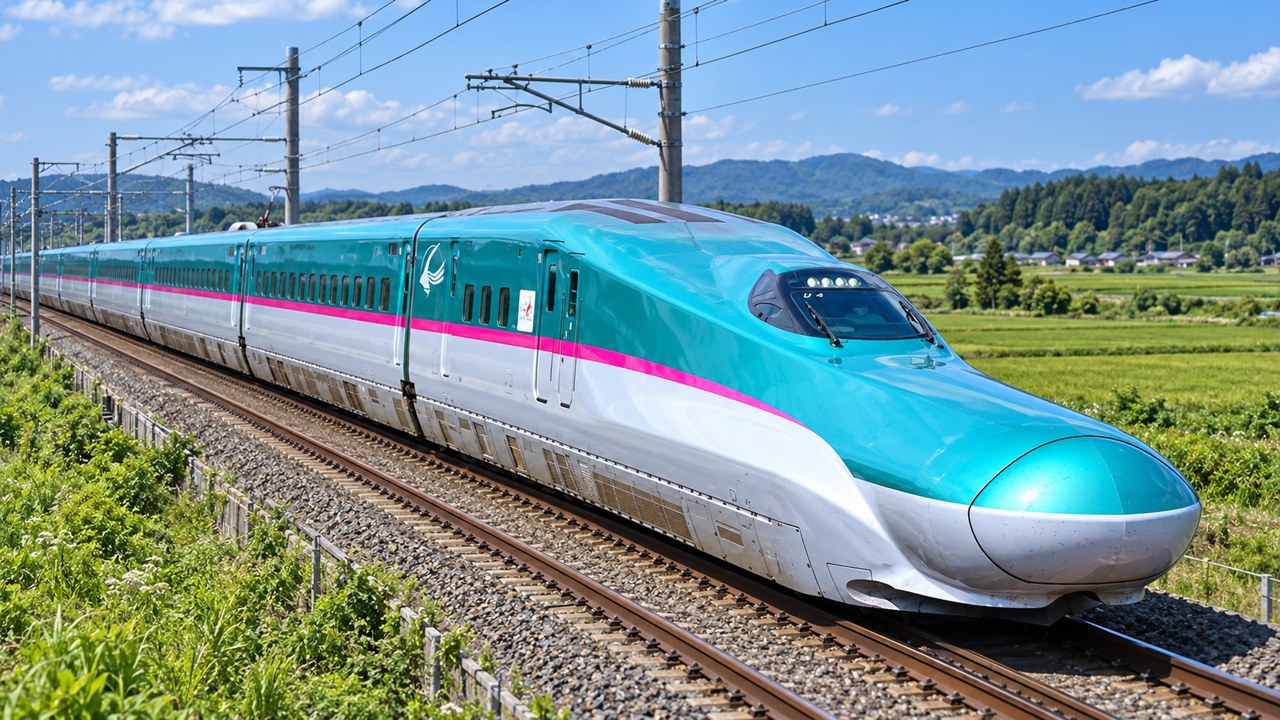
The nose seems to go on forever. Long before it reaches the windscreen, the body stretches into a low, smooth point that makes the E5 one of the most recognisable Shinkansen trains. Its striking shape addresses a problem that arises when a fast train enters a tunnel: the air ahead of it also needs somewhere to go.
The approaching train creates a pressure wave that travels through the tunnel and can produce a loud noise as it emerges from the far end. Lengthening and carefully shaping the nose softens that pressure change. On the E5, the aerodynamic nose is fifteen metres long. Its silhouette shows how strongly a train's surroundings can influence its design.
On 5 March 2011, JR East introduced the E5 on Hayabusa services along the Tōhoku Shinkansen. Initially, it reached 300 kilometres per hour on the authorised section between Utsunomiya and Morioka. The fastest services linked Tokyo and Shin-Aomori in three hours and ten minutes. The new trains took advantage of the extension to Shin-Aomori, which had opened in December 2010.
Years of testing with the experimental FASTECH 360 lay behind the passenger train. That programme investigated how to raise speeds while maintaining safety, comfort and acceptable noise levels. Developing the E5 meant turning test results into a vehicle suitable for everyday operation, with space for passengers and components that could be maintained reliably.
Noise control continued beyond the nose. The pantographs incorporated measures to reduce sound, while bogie covers, sound-absorbing panels and the connections between coaches helped control other noise sources. Inside, active suspension reduced sideways movement, and a body-tilting system improved comfort on curves.
The ten-car train also introduced GranClass, a travel category above Green Car. Its exterior combined green and white with a narrow pink stripe; the interior aimed to make high speed feel like a calm journey.
On 16 March 2013, the next step arrived: 320 kilometres per hour. The E5 had entered service with room to grow. Its long nose became the visible signature of much less obvious work on airflow, noise and the comfort of the people travelling aboard.